

Other Reports
Insert text about what these reports are.
Food Security in Canada
This Public Forum gathered experts in the field of food systems to discuss policy recommendations to fight against food insecurity in Canada.
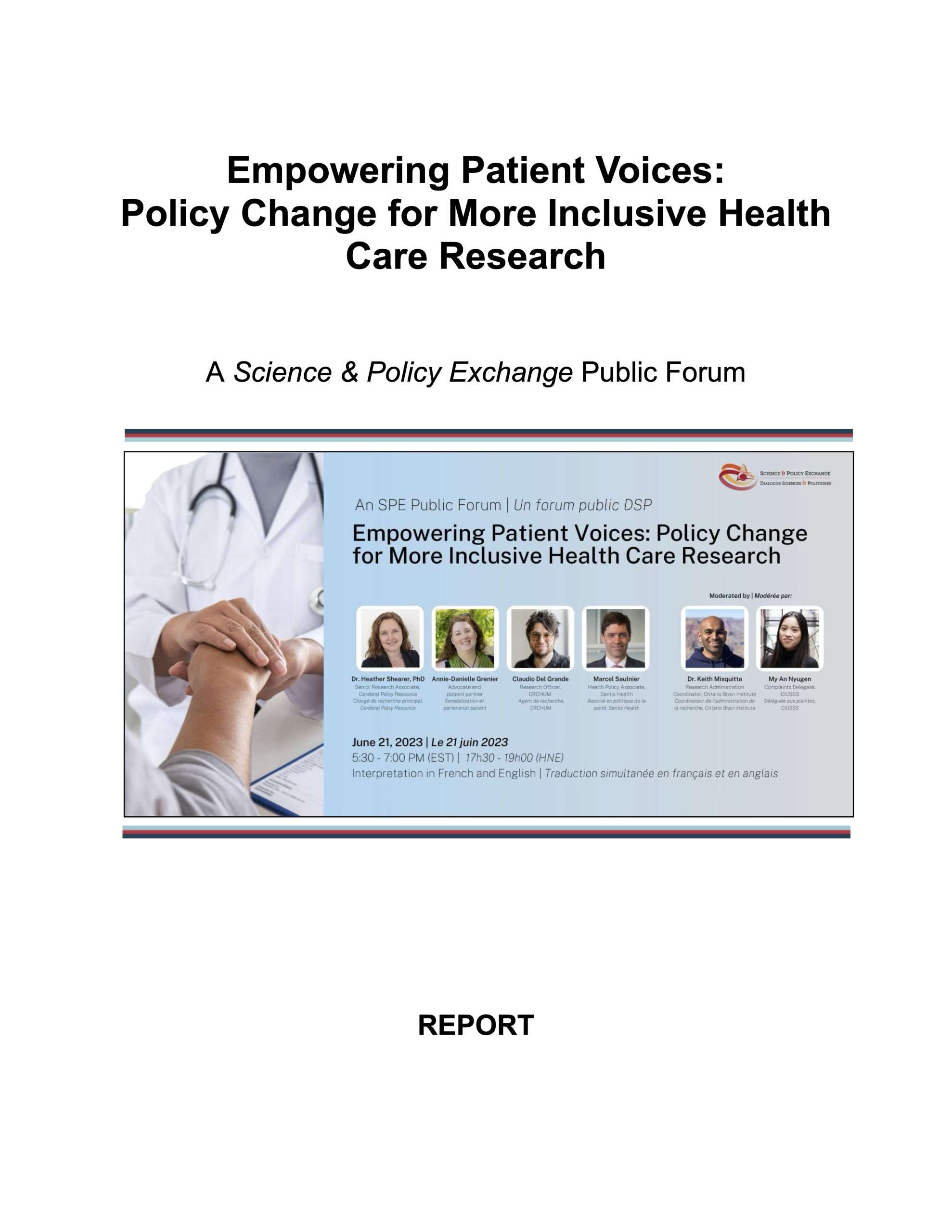
Empowering Patient Voices: Policy Change for More Inclusive Health Care Research
On this panel, experts on the subject of patient inclusion from the patient, researcher, and policy perspectives discuss the best practices and ongoing challenges for the inclusion of patient partners in Canadian health research.
CATALYSING COLLABORATIONS:
“Exploring the Future Based on Lessons Learned”
Health Innovation Initiative, imagine ideation, and Science & Policy Exchange are pleased to present our first report on the collaborative landscape of health innovation in Canada following our panel discussion, “Catalysing Collaborations: Exploring the Future Based on Lessons Learned.”Throughout the event and in follow-up discussions with the broader community, we identified barriers to and actions for enabling effective collaborations between the government, researchers, and healthcare workers during and beyond the COVID-19 pandemic. This report provides an overview of some of the themes that emerged.
EDI in Action:
Best Practices and Future Directions
The past few years have been a time of heightened attention for equity, diversity, and inclusion (EDI) in academic institutions and in the larger community. This has resulted in a greater awareness of the barriers and challenges faced by under-represented groups in academia. In order to harness this heightened awareness to truly make academic institutions more diverse, inclusive, and equitable, it is necessary to create and enact action plans that create meaningful and concrete change in policy.

Bursting the Academic Bubble Panel
In early 2021, reports by the Canadian Council of Academies and CCUNESCO were published detailing the challenges of PhD graduates in Canada as they transition towards the labour market.
Building upon this report, Science & Policy Exchange held a virtual panel discussion on February 18, 2021, to elaborate on these challenges while also highlighting promising practices to address them. Key recommendations are found in this report.
Health and Misinformation: Disentangling Truth and Falsehood
The internet and social media have increased the accessibility of health information but have also fostered the spread of potentially damaging health misinformation online, associated with risks at the personal and societal level.
SPE organized a public forum with experts in science communication and information literacy applied to health contexts, and addressed the topic of misinformation by reviewing the factors that play a role in spreading it, contrasting the effectiveness of different approaches to promote access to accurate and reliable information, and delineating relevant recommendations and strategies that can potentially be useful from a public policy perspective.
Waste Streams: Can we stem the plastic tide?
Science & Policy Exchange (SPE) held a public forum entitled “WASTE STREAMS: Can We Stem the Plastic Tide?” with the goal of bringing the public together with researchers and professionals involved in addressing plastic pollution in waterways. This report summarizes the perspectives of our panelists, as well as the concerns raised by the general public during the question period.
Zero-waste: Reality or Fantasy?
Science & Policy Exchange (SPE) and Climatable hosted a two-hour public forum “SPEForum: Zero Waste Cities – Reality or Fantasy?” on June 4, 2019, at BAnQ, Montreal, to learn and discuss the challenges and opportunities that come with transforming into a zero waste city. This was an opportunity for the public to ask questions and engage with leading experts in research and policy to help answer them. The panelists were Alex Tyrrell, leader of the Green Party of Québec; Mariève Isabel, Montreal Urban Sustainability Experience, McGill University; Sophie Bernard, Department of Mathematics and Industrial Engineering, Polytechnique Montréal. The forum represented a policy, production, and consumer perspectives – to address how we can achieve our ambitious sustainability goals
#SPESciAdvice
A Science Advice Workshop for the Next Generation
Training the next generation of scientists and researchers is very important. We believe that research excellence requires understanding the impact of research on the community, in particular, the impact of research on policy. This workshop provided a selected pool of students and early career researchers (ECRs) with experience in government advice and interaction with key stakeholders at the government.
Students as Stakeholders in Science Diplomacy
It is with great pleasure that we present to you this report, summarizing fruitful discussions on the role of students in science diplomacy. In advance of Canada’s G7 presidency, numerous discussions in Québec and Canada highlighted the intersection of science and diplomacy and pointed to a key recommendation which remains unexplored: to advance science diplomacy, we must engage students and early career scientists.

